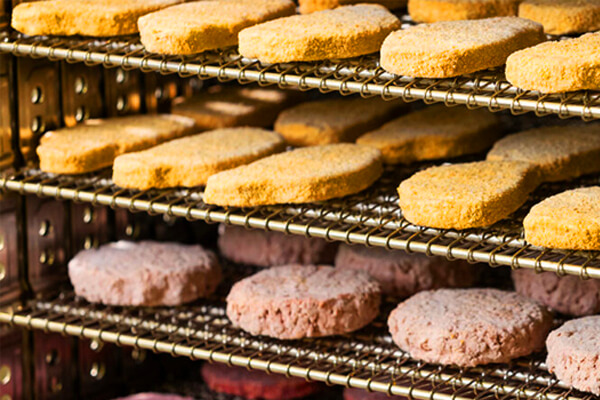
In the modern frozen-food processing industry, the demand for higher efficiency, stable throughput, and continuous production has led to the widespread adoption of Self-Stacking Spiral Belts. These belts are a core component of self-stacking spiral freezer systems, widely used in IQF lines for poultry, seafood, bakery items, fruits, vegetables, ready meals, and more. Their unique structure and self-supporting design deliver optimal airflow, energy efficiency, and minimal maintenance.
1. What Is a Self-Stacking Spiral Belt?
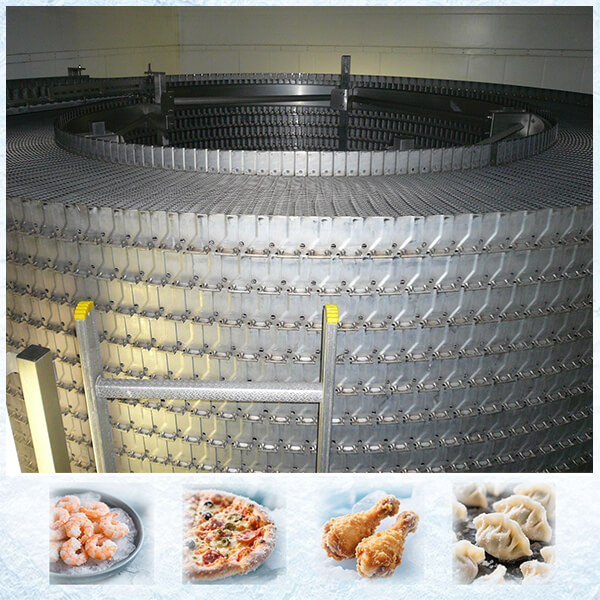
A Self-Stacking Spiral Belt (also known as a self-supporting spiral belt or self-stacking freezer belt) is a type of conveyor belt used inside spiral freezers where the belt forms a self-supported spiral tower without the need for traditional inner cage drums.
Compared with conventional spiral belts that require drive cages, the self-stacking design enables:
- Higher production capacity per footprint
- Optimized airflow distribution
- Reduced mechanical complexity
- Lower energy consumption
- Simplified installation and maintenance
Because the belt itself locks and supports each tier, the entire system becomes more stable, flexible, and hygienic—perfect for continuous freezing environments.
2. Working Principle of the Self-Stacking Spiral Belt
The Self-Stacking Spiral Belt works based on a lifting and locking mechanism integrated into the belt structure. Its operating principles include:
2.1 Self-Supporting Geometry
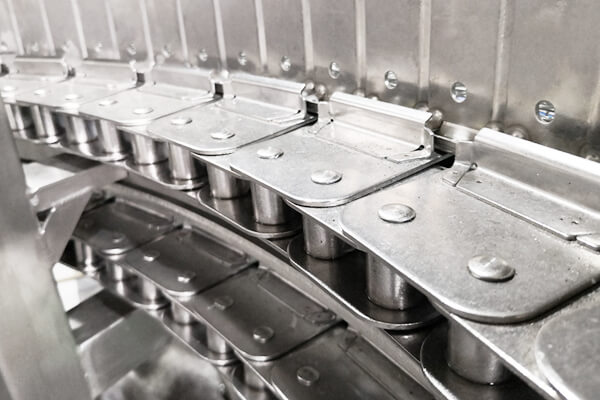
Each tier of the belt overlaps and supports the tier above it through vertical stacking tabs or interlocking edges. As the belt moves upward or downward in the spiral path, these tabs automatically engage, creating a stable spiral column.
This design eliminates the need for:
- Inner cage drum
- Separate steel tier supports
- Additional mechanical guiding components
The belt becomes the structure.
2.2 Friction-Driven or Direct-Driven Movement
Self-stacking belts typically operate using:
- Low-tension friction drives
- Direct drives integrated into the belt edge
The result is smooth movement even under high loads and low temperatures.
2.3 Controlled Lifting on the Infeed Section
At the bottom infeed section, the belt is slightly lifted so that new layers can stack on the previous level. This automatic lifting action is fundamental to the self-stacking process.
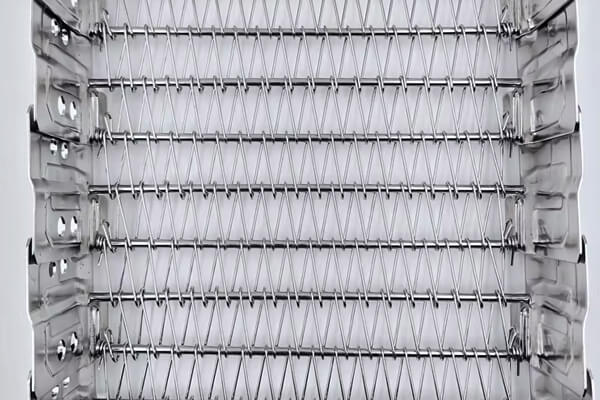
2.4 Enhanced Airflow Through Large Open Area
Because the belt has an open mesh structure, the refrigerant airflow moves uniformly through the product layers, achieving:
- Rapid heat transfer
- Uniform freezing
- Reduced freezing time
- Lower energy consumption
This is especially important in IQF processes where product quality depends on preserving shape, texture, and nutritional value.
3. Structural Features of Self-Stacking Spiral Belts
A Self-Stacking Spiral Belt is engineered to perform under extreme processing conditions, such as −40°C freezer environments, high humidity, and continuous operation. Key structural features include:
3.1 High-Strength Stainless Steel Construction
Most belts are manufactured from food-grade stainless steels such as:
- 304 stainless steel
- 316L stainless steel (for corrosion-resistant applications)
These materials provide:
- Excellent resistance to freezing environments
- Superior hygiene
- Long service life
3.2 Interlocking Edge or Vertical Tab Design
The defining feature is the self-stacking mechanism, achieved through:
- Vertical stacker links
- Upturned edge tabs
- Interlocking side structures
These allow the belt to support itself without external support rails.
3.3 Large Open Area Mesh
The central belt body often uses:
- Balanced weave mesh
- Compound weave mesh
- Modular spiral mesh
The open area ensures maximum airflow for efficient freezing.
3.4 Smooth, Sanitary Belt Surface
Designed according to food safety standards (e.g., FDA/EC compliance), the surface minimizes contamination risks and simplifies cleaning.
3.5 Variable Pitch and Width Options
To match different freezer sizes, the belt can be customized in:
- Width (usually 600–1400 mm)
- Pitch
- Edge structure
- Mesh weave type
This design flexibility supports both large-capacity industrial freezers and compact systems.
4. Advantages for the IQF Freezing Industry
Self-Stacking Spiral Belts provide several performance advantages:
- Compact Footprint – Higher production capacity in limited space
- Energy Efficiency – Uniform airflow reduces refrigeration load
- Lower Maintenance – Fewer mechanical parts mean fewer breakdowns
- High Stability – Self-supporting structure ensures smooth operation
- Better Product Quality – Faster freezing prevents cell damage and dehydration
- High Throughput – Ideal for continuous, 24/7 production lines
These advantages make the belt essential in modern IQF plants.
5. Suitable Products for Self-Stacking Spiral Belts
Thanks to flexibility, large open area, and hygienic design, Self-Stacking Spiral Belts are suitable for a wide range of frozen and chilled products.
5.1 Meat and Poultry
- IQF chicken breast, wings, nuggets
- Pork and beef portions
- Sausages and meatballs
5.2 Seafood
- Shrimp
- Fish fillets
- Squid rings
- Surimi products
5.3 Bakery and Dough Products
- Bread and buns
- Croissants and pastries
- Pizza crust
- Ready-to-bake dough
5.4 Fruits and Vegetables
- Berries
- Corn, peas, carrots
- Mixed vegetables
5.5 Ready Meals and Processed Foods
- Noodles and pasta
- Dumplings
- Frozen snacks
- Pre-cooked dishes
5.6 Dairy Products
- Ice cream
- Cheese blocks or slices
In general, any food requiring rapid, uniform, and gentle freezing can benefit from a self-stacking spiral belt system.
 +86-15369679157